Guide
What Is BPH? Enlarged Prostate Basics, Symptoms and Warning Signs
BPH, short for benign prostatic hyperplasia, is a noncancerous growth of the prostate that can squeeze the urethra and slow urine flow. It affects about 5% to 6% of men aged 40 to 64 and 29% to 33% of men 65 and older (NIDDK, Prostate Enlargement (BPH)). A weak stream or night trips to pee need a doctor's check, since several conditions look alike.
Written by the Protoflow label deskUpdated
The basics
What is BPH, and what does the prostate do?
BPH is a growth of the prostate that is not cancer. The gland wraps around the urethra, so growth can narrow the channel.
BPH, or benign prostatic hyperplasia, is the medical name for an enlarged prostate. "Benign" means it is not cancer. "Hyperplasia" means the gland has more cells than before (NIDDK, Prostate Enlargement (BPH)).
The prostate is a walnut-sized gland below the bladder. It makes part of the fluid in semen. The urethra, the tube that carries urine out, runs through its middle. When the gland grows, it can press on that tube and make the bladder work harder (MedlinePlus, Enlarged Prostate).
BPH is the most common prostate condition in men over 50. It does not raise the risk of prostate cancer (MedlinePlus, Enlarged Prostate). The drawing shows the four points where flow can change.
- 1. Bladder
Stores urine. When it squeezes, urine flows down the urethra.
- 2. Prostate
A walnut-sized gland wrapped around the urethra just below the bladder.
- 3. Urethra
The channel urine flows through. The prostate surrounds its first part.
- 4. Enlarged prostate (BPH)
As the gland grows, it can squeeze the channel: a weak stream, straining, getting up at night.
A drawing made for this site, not a medical image. Size does not always match symptoms. Sources: NIDDK (NIDDK, Prostate Enlargement (BPH)) and MedlinePlus (MedlinePlus, Enlarged Prostate).
Risk goes up with age 40 or older, a family history, obesity, heart disease, type 2 diabetes, erectile dysfunction and inactivity (MedlinePlus, Enlarged Prostate). No proven way to prevent BPH exists.
Age and numbers
At what age does the prostate start to grow?
The numbers climb with age: about 5% to 6% of men 40 to 64, and 29% to 33% of men 65 and older.
BPH is rare in young men and becomes common with age. NIDDK counts about 5% to 6% of men aged 40 to 64 and 29% to 33% of men 65 and older (NIDDK, Prostate Enlargement (BPH)). Age 40 is when the list of risk factors begins to apply (MedlinePlus, Enlarged Prostate).
Gland size and symptoms do not always match. A man with a large prostate may have mild symptoms, and a man with a modest one may have strong ones (NIDDK, Prostate Enlargement (BPH)). So a check by a doctor tells you more than a guess from your age.
Symptoms
What are the first signs of an enlarged prostate?
A weak or stop-start stream, trouble starting, urgency, and getting up at night to pee.
The first signs of an enlarged prostate are changes in how you pee. Doctors group them as lower urinary tract symptoms. They tend to creep in slowly, so many men take them for normal aging (NHS, Enlarged Prostate).
The NHS lists these common signs (NHS, Enlarged Prostate):
- Difficulty starting to pee, or straining
- A weak flow, or one that stops and starts
- A feeling that the bladder is not empty
- Dribbling after you finish
- Needing to pee more often or more urgently, including at night
Any one of these can have another cause. Infection, diabetes and some medicines can do the same. See a doctor for a cause rather than assuming BPH (NHS, Enlarged Prostate).
BPH or something else
Is an enlarged prostate cancer?
No. BPH is not cancer and does not raise the risk of it. The symptoms can overlap, which is why a check matters.
An enlarged prostate is not cancer. The NHS and MedlinePlus both say BPH does not cause prostate cancer and does not make it more likely (MedlinePlus, Enlarged Prostate) (NHS, Enlarged Prostate). A man can, however, have BPH and cancer at once.
Because symptoms can match other conditions, including prostate cancer, they should be checked (NHS, Enlarged Prostate). The table sorts the three conditions men most often ask about.
| Condition | What it is | Clue |
|---|---|---|
| BPH | Noncancerous growth of the gland (NIDDK, Prostate Enlargement (BPH)) | Slow-building flow changes |
| Prostatitis | Inflammation of the gland (NIDDK, Prostatitis) | Pain between scrotum and anus; sudden fever and chills in the acute form |
| Prostate cancer | A malignant growth | May cause no symptoms early; found by a doctor's tests |
A PSA blood test is one tool. BPH and prostatitis can raise PSA, and so can infection and a recent biopsy (NCI, PSA Test Fact Sheet). Whether to screen is a personal decision made with a clinician; the USPSTF puts men 55 to 69 in that group, as of its 2018 statement (USPSTF, Prostate Cancer Screening).
Night urination
Why do I get up at night to pee?
Many things cause it, and BPH is only one. Evening fluids, caffeine, alcohol, diabetes and sleep apnea are others.
Waking to pee is called nocturia. An enlarged prostate is a common cause, but it is far from the only one (MedlinePlus, Urinating more at night).
That is why a doctor looks at the whole picture before naming a cause. Contact a provider if it lasts several days, if the number of trips bothers you, or if peeing burns or hurts (MedlinePlus, Urinating more at night).
| Cause | What to ask about |
|---|---|
| Evening drinks | Fluids, caffeine or alcohol late in the day |
| Enlarged prostate | Weak stream, urgency, a bladder that never feels empty |
| Urinary infection | Burning or pain when peeing |
| Diabetes | Thirst, high blood sugar readings |
| Sleep apnea | Loud snoring, daytime sleepiness |
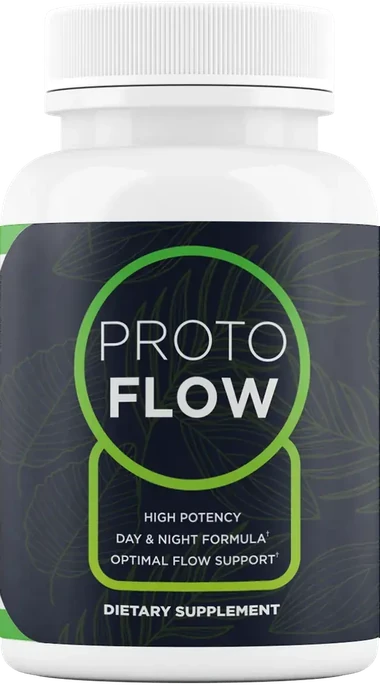
Protoflow: from $1.63 a day60 capsules a bottle · packs of 2, 3 or 6 · 60-day money-back guarantee
See packsWarning signs
Which urinary symptoms need care right away?
Being unable to pee, blood in the urine, fever and chills with painful peeing, and severe lower belly pain.
These four signs need urgent care. Do not wait for a routine visit (NIDDK, Prostate Enlargement (BPH)) (MedlinePlus, Enlarged Prostate).
Untreated BPH can lead to infections, bladder stones and kidney damage (MedlinePlus, Enlarged Prostate).
- Can't peeUnable to pass urine at all, or only a few drops
- Blood in urinePink, red or cola-colored pee
- Fever and painFever and chills with painful or burning peeing
- Belly painGreat pain or swelling in the lower belly
- Back pain, weight lossNew bone or back pain with weight loss you cannot explain
See a doctorFor a weak or stop-start stream, straining, dribbling, a sudden urge, or waking to pee night after night. These are common and treatable, and the cause should be checked, including prostate cancer.
Get care nowFor the first four signs above: go to urgent care or an emergency room, or call 911. Do not wait to see if a supplement helps.
Signs from NIDDK (NIDDK, Prostate Enlargement (BPH)), MedlinePlus (MedlinePlus, Enlarged Prostate) and the NHS (NHS, Enlarged Prostate). A supplement never replaces an exam.
Do not stop or change tamsulosin, finasteride or any other prescribed medicine because of a supplement or an article. Ask your doctor first.
Tests
What tests does a doctor use for urinary symptoms?
A medication review, an exam, a urine test and often a PSA blood test.
A doctor works out the cause before choosing a treatment. Diagnosis can include a review of your medicines, a rectal exam, urine tests and a PSA blood test (MedlinePlus, Enlarged Prostate).
Treatment follows the result. Options range from watchful waiting to medicines, procedures and surgery (NIDDK, Prostate Enlargement (BPH)). The American Urological Association publishes a guideline for managing these symptoms, last updated in 2026 (AUA, BPH/LUTS Guideline (2026)).
Self-help
Can diet and lifestyle change urinary symptoms?
They can help some men. The NHS suggests less alcohol and caffeine, fewer fluids before bed, and a check of your medicines.
Small habits can ease mild symptoms. The NHS lists cutting back on alcohol and caffeine, limiting fluids before bed and asking whether another medicine is making symptoms worse (NHS, Enlarged Prostate).
- Move most fluids to the morning and afternoon
- Ask your doctor whether any of your medicines change urine flow, and never stop them on your own
- Keep a three-day diary of bathroom trips; doctors find it useful
These steps do not replace a diagnosis.
Next steps
When should I see a doctor, and where do supplements fit?
See a doctor for any lasting change in your stream. A supplement is not a diagnosis or a treatment.
Make an appointment if any item below fits you. A primary care doctor can start the checks and refer you to a urologist if needed.
- Weak, slow or stop-start stream for more than a few days
- Waking to pee more than usual, or trips that bother you
- A feeling the bladder never empties
- Pain or burning when peeing
- Symptoms alongside diabetes, heart or kidney disease
Many supplements are sold for prostate "flow", and the sales page for Protoflow calls it "Protoflow 24/7/365 Prostate Support". A dietary supplement does not diagnose, treat or prevent a disease, and FDA does not approve it before sale (FDA, Dietary Supplements Q&A). Saw palmetto, the best-known prostate herb, made little or no difference to urinary symptoms in a review of 27 trials (Cochrane review, Franco 2023).
Read the prostate supplements guide to judge a label, and check the medicine interaction guide and who Protoflow is for before you buy anything.
FAQ
Protoflow questions people ask
01What is benign prostatic hyperplasia?
Benign prostatic hyperplasia, or BPH, is a noncancerous growth of the prostate. The gland wraps around the urethra, so growth can squeeze it and cause a weak stream, urgency or night trips to pee. It is the most common prostate condition in men over 50 (MedlinePlus, Enlarged Prostate).
02At what age does the prostate start to grow?
BPH becomes more likely from about age 40. NIDDK counts about 5% to 6% of men aged 40 to 64 and 29% to 33% of men 65 and older with it (NIDDK, Prostate Enlargement (BPH)). Gland size and symptom strength do not always match, so a doctor's check beats guessing from age.
03Is an enlarged prostate cancer?
No. An enlarged prostate is not cancer and does not raise the risk of it (MedlinePlus, Enlarged Prostate). Still, the symptoms can overlap with prostate cancer and other conditions, so the NHS says they should be checked (NHS, Enlarged Prostate). A man can also have both at once.
04What are the first signs of an enlarged prostate?
The first signs are trouble starting to pee, a weak or stop-start stream, a bladder that feels never empty, dribbling after you finish, and needing to go often or urgently, including at night (NHS, Enlarged Prostate). Other conditions can cause the same, so see a doctor.
05What tests does a doctor use for urinary symptoms?
Doctors often review your medicines, perform a rectal exam, test your urine and order a PSA blood test (MedlinePlus, Enlarged Prostate). PSA has no single cut-off, and BPH, prostatitis and infection can all raise it (NCI, PSA Test Fact Sheet). Results guide the choice of treatment.
06Can diet and lifestyle change urinary symptoms?
They can help some men. The NHS suggests cutting back on alcohol and caffeine, limiting fluids before bed and checking whether other medicines worsen symptoms (NHS, Enlarged Prostate). These steps do not replace a diagnosis, so see a doctor if symptoms last or bother you.
Who wrote this
Written and reviewed by
Pages built from the Protoflow label, the sales page and linked NIH, FDA, FTC, NHS and peer-reviewed sources.
Last updated . Learn about our editorial standards and how we check reviews. This website is run by Goprotoflow, a licensed U.S. retail desk for Protoflow, not by the manufacturer or by PhytoThrive Labs. We earn money when you buy through our order links.
Keep reading
More about Protoflow

Licensed U.S. retail desk for Protoflow
Ready to try Protoflow?
Check your medicines first, then pick a pack. Bigger packs cost less per day, and the 60-day money-back guarantee gives you two months to judge it.
- Secure ClickBank checkout
- 60-day guarantee
- Free US shipping on 3 and 6 bottles